


When evaluating connectivity solutions, many organizations focus on bandwidth. But bandwidth alone doesn’t determine how applications perform in the real world.
For remote operations, understanding the difference between bandwidth and throughput is critical. Whether you’re supporting a mine site, offshore platform, rail network, enterprise branch, humanitarian mission, or remote energy asset, what matters most is not the network’s theoretical capacity, but the actual amount of data successfully delivered to users and applications.


What is Bandwidth?
Bandwidth refers to the maximum amount of data a network can transmit, typically measured in Mbps (megabits per second) or Gbps (gigabits per second).
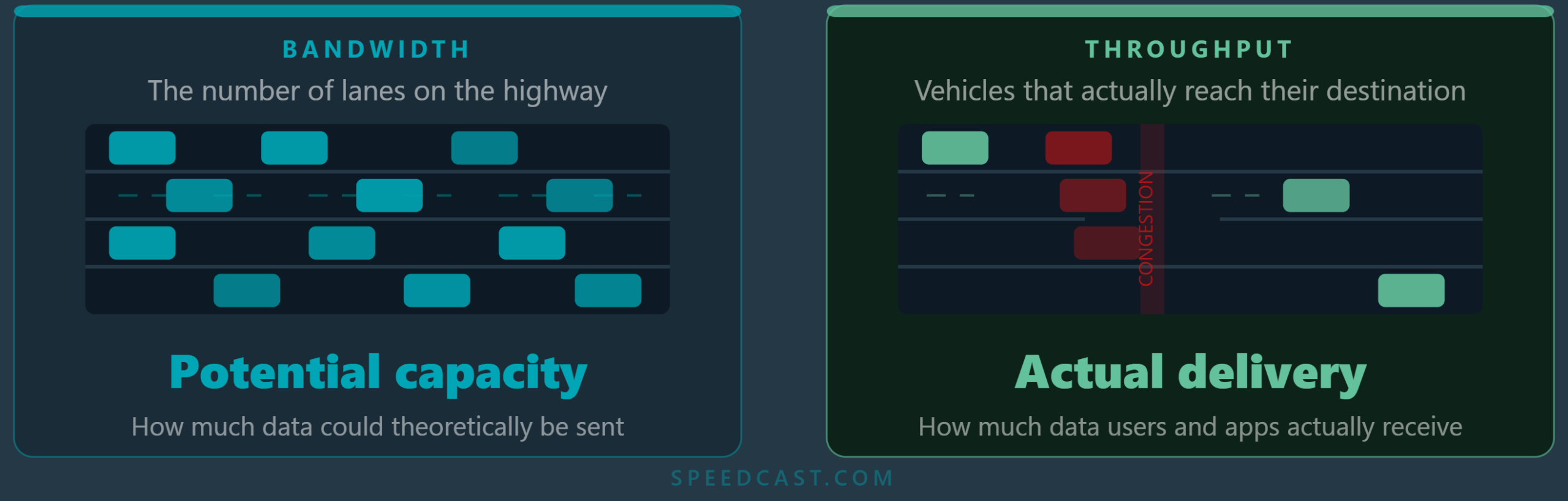
Think of bandwidth as the number of lanes on a highway.
The more lanes available, the more vehicles can potentially travel at the same time.
For example:
- A 100 Mbps service has more bandwidth than a 20 Mbps service.
- A 1 Gbps service has more bandwidth than a 100 Mbps service.
Bandwidth describes the network’s potential capacity, not its actual performance.
What is Throughput?
Throughput is the actual amount of data successfully delivered across the network over a given period.
Using the highway analogy, throughput is the number of vehicles that actually reach their destination.
Even on a multi-lane highway, accidents, congestion, weather, or roadworks can reduce traffic flow. Similarly, network performance can be affected by:
- Congestion
- Latency
- Packet loss
- Network contention
- Application overhead
- Signal quality
- Routing inefficiencies
As a result, throughput is often lower than the available bandwidth.

Bandwidth vs. Throughput: A Simple Example
A network may offer significant bandwidth, but if throughput is poor, users may still experience:
- Slow file transfers
- Choppy or dropped video calls
- Delayed cloud applications
- Poor user experience
- Reduced operational efficiency
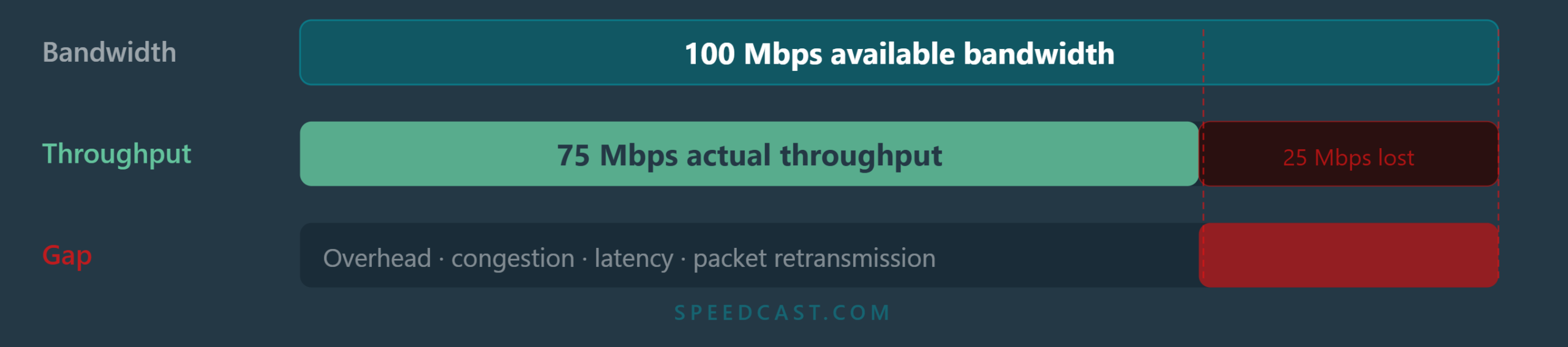

Organizations operating in remote environments often focus on obtaining more bandwidth. However, increasing bandwidth doesn’t always solve performance issues.

A remote energy site might have:
- 500 Mbps of available bandwidth
- Multiple cloud applications
- Video surveillance systems
- IoT devices
- Remote users
- Operational technology systems
If traffic isn’t intelligently managed, critical applications may still experience poor performance despite having large amounts of bandwidth available.
For operational environments, throughput often becomes the more meaningful measure of network effectiveness.
What Impacts Throughput?
Latency
Latency is the time required for data to travel across the network.
Higher latency can reduce application responsiveness and negatively impact throughput, particularly for:
- Cloud applications
- Video conferencing
- Remote desktops
- Interactive systems
This is one reason why LEO satellite networks such as Starlink and OneWeb have gained popularity. Their lower orbital altitude helps reduce latency compared to traditional GEO services.

Packet Loss
When data packets are lost during transmission, they must be resent.
The result:
- Reduced throughput
- Increased delays
- Lower application performance
Packet loss can have a significant impact on satellite, cellular, and hybrid networks.

Network Congestion
When multiple users and applications compete for available resources, throughput can decline.
Examples include:
- Shift changes at remote camps
- Large software updates
- Streaming traffic
- Increased cloud usage
Without intelligent traffic management, important business applications may compete with recreational traffic.

Protocol and Security Overhead
Network security, encryption, VPNs, and communications protocols consume a portion of available bandwidth.
This overhead is necessary for security and reliability, but it can reduce the amount of usable throughput.


Why Bandwidth Alone Can Be Misleading
Many service providers advertise maximum bandwidth.
However, buyers should also ask:
- What throughput can I realistically expect?
- How does performance change during peak usage?
- How is traffic prioritized?
- What happens when multiple applications compete for resources?
- How are latency and packet loss managed?
These questions often reveal more about user experience than headline bandwidth numbers.
The Role of CIR and MIR
For business-critical operations, two additional metrics are often important.
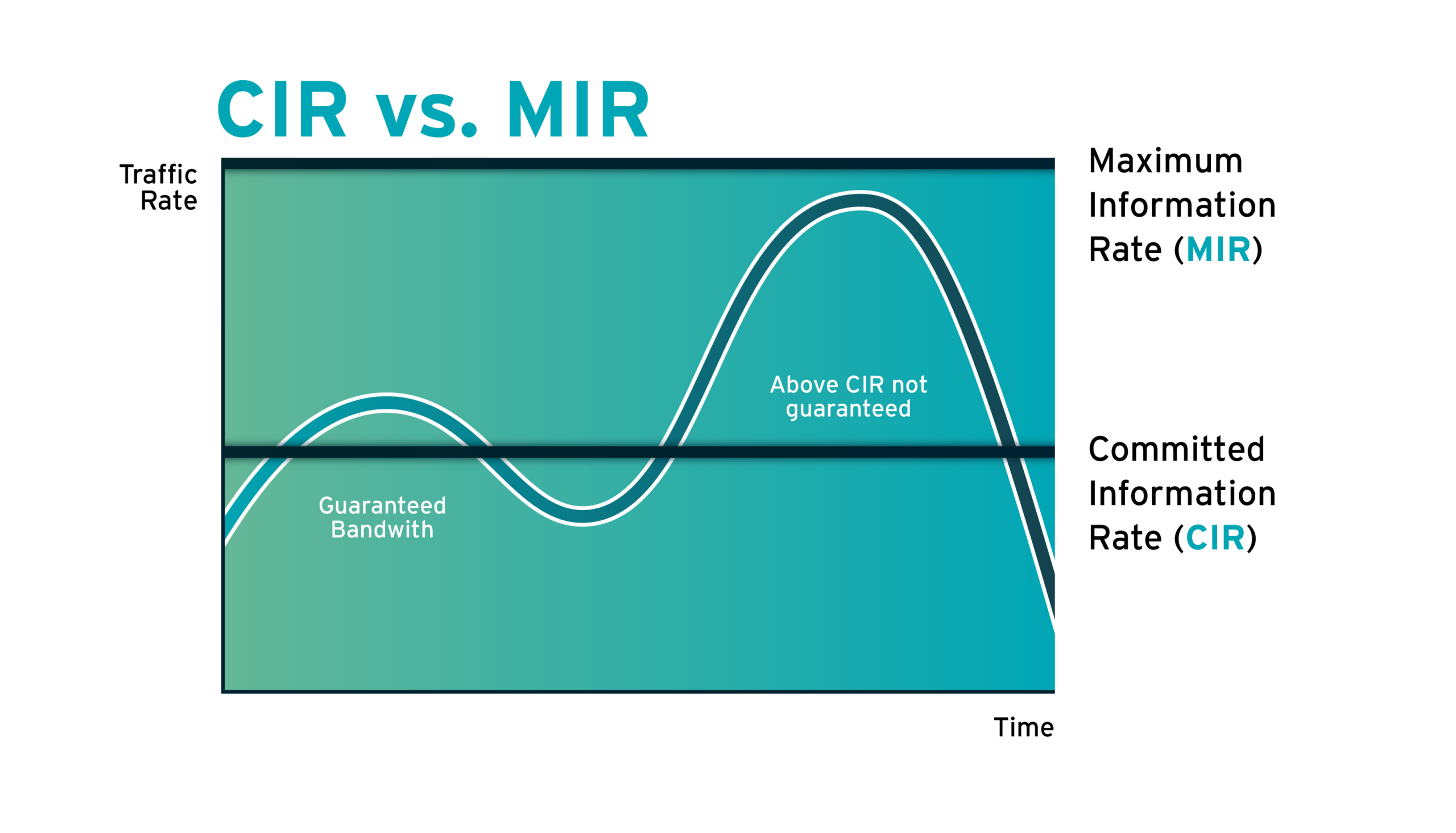
Committed Information Rate (CIR)
CIR is the amount of bandwidth guaranteed to be available.
This ensures critical applications continue to perform even during periods of congestion.
Maximum Information Rate (MIR)
MIR represents the maximum bandwidth that can be achieved when capacity is available.
Many enterprise satellite services combine CIR and MIR to balance consistent performance with flexibility.

Improving throughput isn’t always about purchasing more bandwidth.
In many cases, organizations can achieve better operational performance by managing existing network resources more effectively.
Speedcast’s SIGMA intelligent edge network management platform helps optimize throughput by:
Intelligent Traffic Routing
Applications can be directed over the most appropriate path based on:
- Latency
- Network health
- Cost
- Policy requirements
Multi-Network Orchestration
SIGMA can leverage:
- Starlink
- Eutelsat OneWeb
- GEO satellite services
- Cellular networks
- Private LTE and 5G
- Terrestrial connectivity
Traffic automatically follows the best-performing route.
Critical business applications receive priority over non-essential traffic.
This helps maintain throughput where it matters most.
Real-Time Network Visibility
Organizations gain visibility into:
- Bandwidth utilization
- Throughput performance
- Application behavior
- Congestion events
- User experience
Bandwidth vs. Throughput: Which one is more important?
The answer is simple:
Bandwidth measures potential. Throughput measures reality.
Bandwidth tells you how much capacity a network could provide under ideal conditions.
Throughput tells you how much data your users, applications, and operations actually receive.
For organizations operating remote sites, critical infrastructure, industrial operations, and distributed enterprises, throughput is often the more meaningful indicator of real-world performance.

How to Improve Throughput and Network Performance
A larger bandwidth number doesn’t always mean a better user experience.
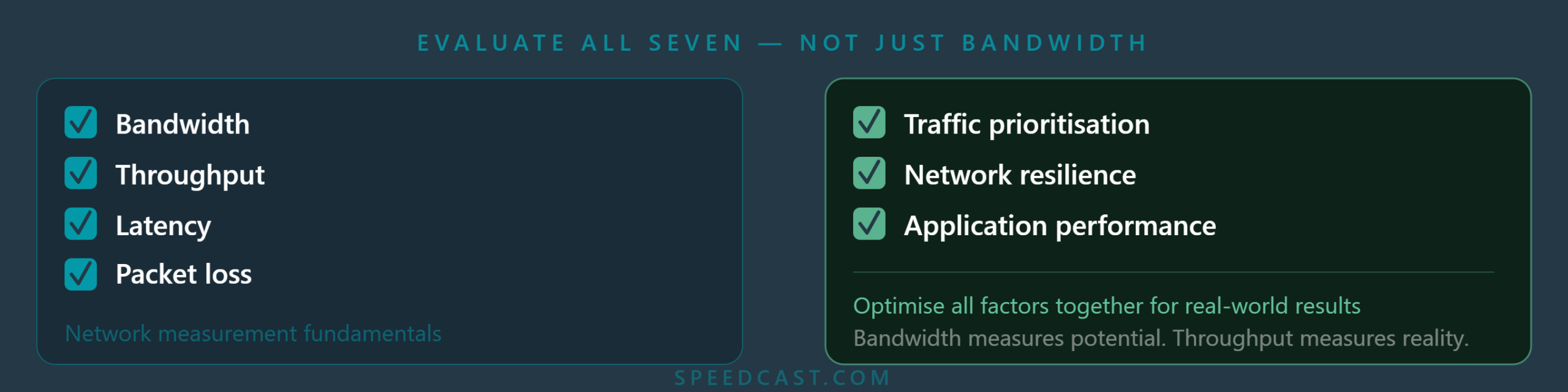
To maximize application performance and operational efficiency, organizations should evaluate:
- Bandwidth
- Throughput
- Latency
- Packet loss
- Traffic prioritization
- Network resilience
- Application performance
The most successful remote operations focus on optimizing all of these factors together.
Ready to get more from your network?
Contact Speedcast to improve throughput, application performance, and connectivity resilience across satellite, cellular, and multi-network environments.