


For years, the national conversation around connectivity in the United States has focused on a single goal: build the infrastructure. Fiber miles laid, towers erected, satellites launched. That work matters, and meaningful progress has been made.
But as we look toward the next decade, it’s becoming clear that connectivity alone is no longer the differentiator. The real opportunity, and the real risk, lies in what happens on top of that infrastructure.
The question facing communities, enterprises, and service providers alike is no longer “Can we connect?”, it’s “What can we enable once we are connected?”.

The Infrastructure Gap Is Closing. The Capability Gap Is Not.

Across much of the country, basic broadband availability has improved dramatically. High‑capacity networks now reach regions once considered unreachable. Public and private investment has made it possible to bring modern connectivity to places long left behind.
Yet outcomes remain uneven. Businesses still struggle to adopt digital tools. Healthcare access remains constrained by geography. Public safety agencies face communication challenges during emergencies. Rural and remote regions continue to lose population and economic momentum.
This is not a speed problem. It’s a capability problem.
True digital inclusion does not come from bandwidth alone. It comes from services, applications, and operational platforms that turn connectivity into economic and social value.

From Connectivity Utility to Digital Enablement Platform
Historically, connectivity providers were utilities. Their role was to deliver access and keep the lights on. That model no longer matches the reality of today’s digital economy.
Modern communities and enterprises need:
- Secure, managed cloud and edge computing
- Cybersecurity and compliance services
- Low‑latency applications for healthcare, education, and industry
- Data sovereignty and local processing
- Resilient backup connectivity for continuity and safety
- Centralized visibility across increasingly complex networks
Delivering these capabilities requires a shift from isolated hardware and siloed services to platform‑based operations at the edge.

A growing share of U.S. data is generated outside traditional data centers: in schools, clinics, farms, vehicles, industrial sites, and public spaces. Sending all that data back to distant clouds introduces latency, cost, and risk.
Edge computing changes the equation:
- Applications run closer to users and devices
- Latency drops from tens of milliseconds to single digits
- Sensitive data stays local when required
- Services remain operational even when backhaul links fail
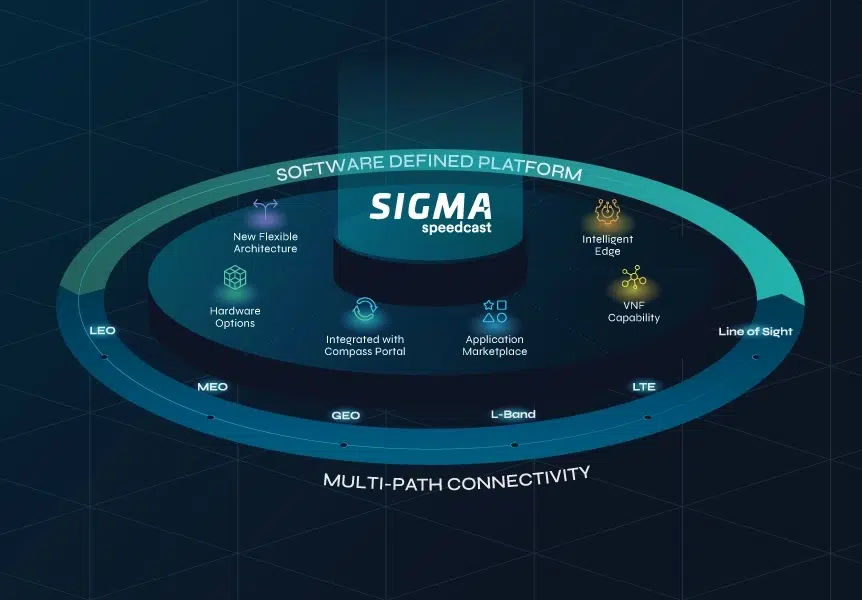
When combined with modern satellite connectivity – particularly low Earth orbit (LEO) systems, such as Starlink, OneWeb and the incoming LEO options, edge platforms can extend these benefits far beyond where fiber alone can reach.
Connectivity as an Economic Multiplier
When connectivity is paired with the right platform and services, it becomes an economic multiplier rather than a static utility.
Consider what becomes possible:
- Healthcare delivered via low‑latency telemedicine instead of long‑distance travel
- Education and workforce training hosted locally for better performance and accessibility
- Agriculture and environmental management powered by AI and sensor data processed at the edge
- Public safety and disaster response supported by resilient, multi‑path connectivity
- Small businesses and entrepreneurs accessing cloud tools without cloud‑grade latency or cost
In these models, connectivity is not the product—it is the enabler.
Operational Reality: Simplicity at Scale
One of the biggest barriers to this transformation has been operational complexity. Too many environments still rely on:
- Multiple hardware appliances for single functions
- Disconnected vendor portals
- Manual provisioning and on‑site updates
- Limited IT staff supporting vast geographies
Edge platforms that consolidate networking, security, compute, and management into a single architecture are changing this reality. With virtualization, zero‑touch provisioning, and centralized orchestration, small teams can operate infrastructure that once required large enterprises.
This operational simplicity is not just an IT benefit, it’s what makes advanced digital services economically viable in more places across the country.


Resilience Is Now a Core Requirement
Extreme weather events, natural disasters, and infrastructure failures are becoming more common. In this environment, connectivity must be resilient by design.
Hybrid architectures that combine fiber, fixed wireless, cellular, and LEO satellite connectivity are increasingly essential. When integrated through intelligent edge platforms, these networks can automatically fail over, maintain service continuity, and preserve critical communications when they are needed most.
Resilience is no longer a premium feature. It is a baseline expectation.
A New Measure of Success for U.S. Connectivity
As the infrastructure phase matures, success in U.S. connectivity should be measured differently.
Not just by:
- Miles of fiber
- Advertised speeds
- Coverage maps
But by:
- Economic participation
- Service accessibility
- Operational resilience
- Local data control
- Community and enterprise outcomes
The next chapter of connectivity in the United States will be defined by those who can turn networks into platforms, and platforms into real‑world impact.

Go beyond connectivity and unlock what’s next.
Speak to a Speedcast expert now.