


When a remote site slows down, the first assumption is often simple: we need more bandwidth.
But when Speedcast analyzed a recent snapshot of the top applications used across all remote sites we support globally, spanning vessels, offshore platforms, industrial locations, and mobile environments, the data told a very different story.
Remote sites don’t usually lose speed because bandwidth is insufficient.
They lose speed because unexpected applications consume bandwidth without control.

What the Data Across Remote Sites Tells Us
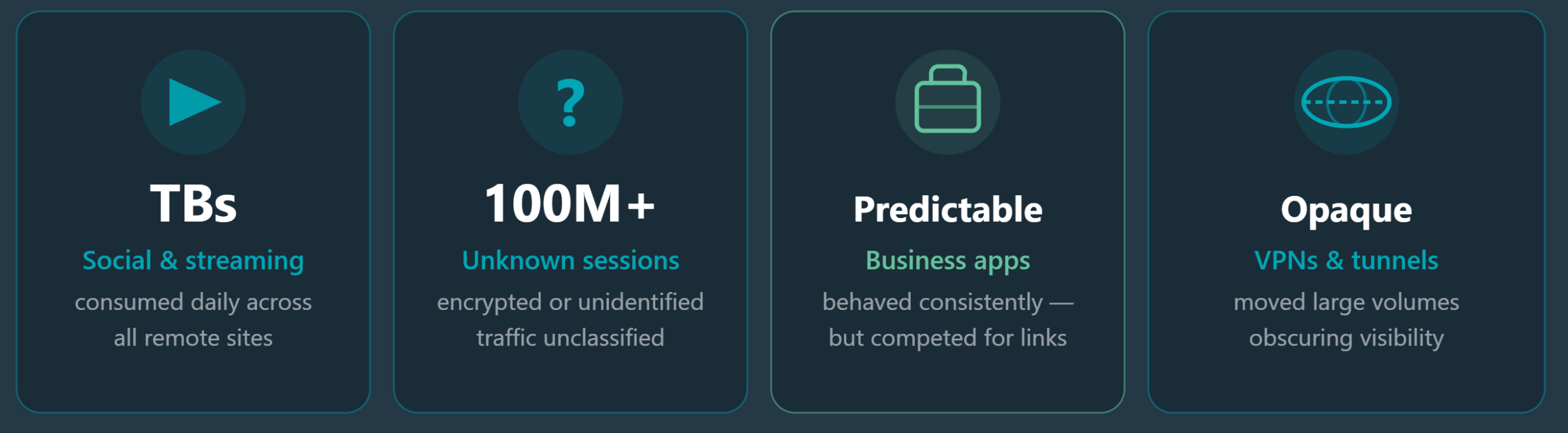
Looking at application usage aggregated across Speedcast‑supported remote environments over a 24‑hour period, a few trends stood out immediately:
- Social media and video streaming applications consumed multiple terabytes of data
- Encrypted or unidentified traffic accounted for a massive share of volume and sessions
- Business applications behaved predictably and consistently
- Tunnels and VPNs moved large volumes of traffic while obscuring visibility
This wasn’t one site or one fleet—it was a cross‑section of real‑world remote operations.
And it explains why performance issues so often appear “out of nowhere.”
Three Surprises Hidden in your Network
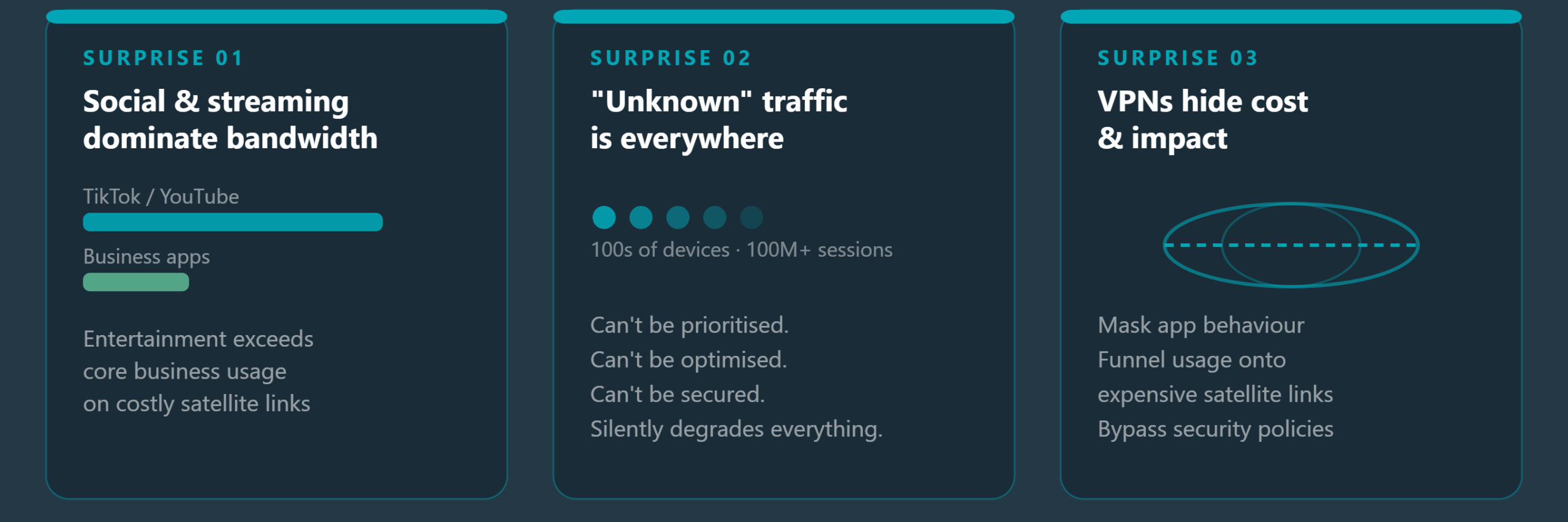

Surprise #1: Non‑Business Applications Dominate Bandwidth
Across remote sites, social platforms and streaming services quietly rose to the top in total data volume:
- Facebook, Instagram, TikTok, and YouTube alone consumed terabytes per day
- Entertainment traffic often exceeded the combined usage of core business systems
This doesn’t mean crew welfare or user access is wrong. It means without application‑aware policies, recreational traffic competes directly with operations, especially over high‑latency, high‑cost satellite links.

Surprise #2: “Unknown” Traffic Is Everywhere
Even more concerning was the scale of traffic labeled as unknown SSL, TCP, or UDP:
- Spanning hundreds of devices
- Generating millions to hundreds of millions of sessions
- Accounting for several terabytes of data
In many cases, this traffic is legitimate, but it is poorly identified, poorly routed, or running through tunnels that bypass network policies.
Without deep application recognition, this traffic:
- Can’t be prioritized
- Can’t be optimized
- Can’t be properly secured
And it silently degrades performance for everything else.

Surprise #3: VPNs Can Hide Cost and Impact
The snapshot also showed encrypted tunnels moving large volumes of traffic with relatively few sessions, suggesting aggregation points somewhere in the network.
While VPNs and tunnels are essential, unmanaged tunnels can:
- Mask application behavior
- Funnel heavy usage onto expensive satellite links
- Circumvent performance and security policies
When tunnels are opaque, networks lose intelligence and optimization becomes impossible.
The Real Issue Isn’t Connectivity, It’s Awareness
What this data makes clear is that remote sites don’t fail because they lack connectivity. They fail because:
- Traffic isn’t classified accurately
- Applications aren’t treated differently
- Links aren’t used intelligently
- Policies aren’t enforced consistently
This is exactly the problem SD‑WAN was designed to solve—but only when SD‑WAN is built for remote, satellite‑dependent environments.

Enterprise-Grade SD‑WAN: Built for Remote Reality
Speedcast’s SIGMA SD‑WAN service applies core SD‑WAN principles, including application awareness, dynamic path selection, and policy‑based control, but adapts them for the realities of satellite, LEO, and hybrid connectivity.
Instead of treating all traffic equally, SIGMA SD‑WAN understands what the traffic is, where it should go, and how it should behave.

Application Visibility: No More Guessing
SIGMA SD‑WAN provides deep, real‑time visibility into application behavior across all remote sites:
- Identify top applications by volume, sessions, or devices
- Classify encrypted and previously “unknown” traffic
- Understand usage patterns by user, site, or time of day
- Surface abnormal or inefficient traffic early
What was once “mystery usage” becomes clearly understood and actionable.
Application‑Aware Steering and Load Balancing
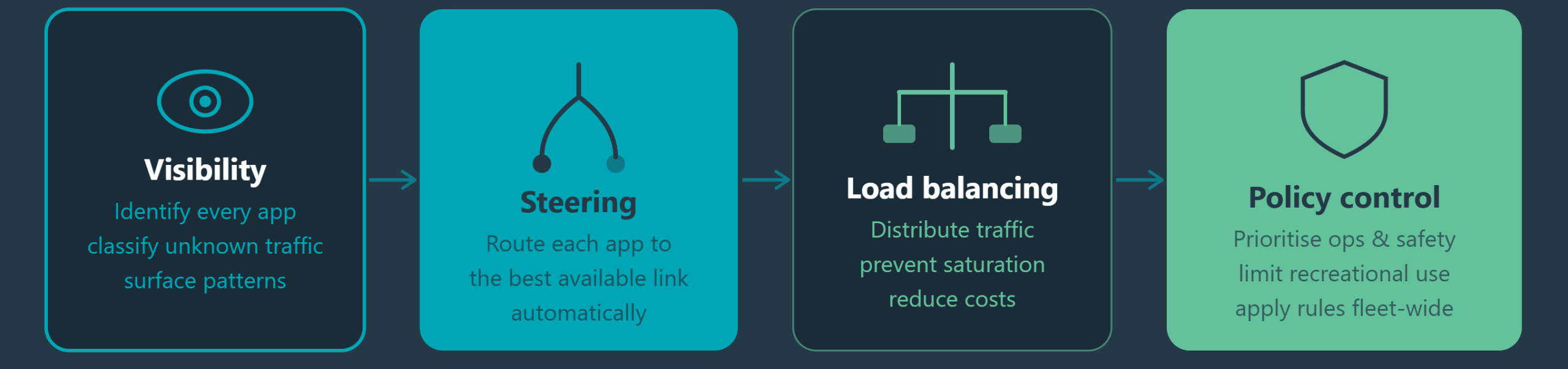
Visibility enables control—and SIGMA SD‑WAN delivers it through:
SIGMA SD‑WAN automatically steers traffic based on:
- Application type and priority
- Link performance (latency, jitter, packet loss)
- Cost and availability of satellite, LEO, LTE, or backup paths
Business‑critical applications are always routed over the best available link—while non‑critical traffic adapts or waits.
Intelligent Load Balancing
Rather than overloading a single satellite path, SIGMA SD‑WAN:
- Distributes traffic across available links
- Prevents bandwidth saturation
- Reduces reliance on expensive capacity
This maximizes performance without automatically increasing bandwidth costs.
Policy‑Driven Optimization at Scale
With SIGMA SD‑WAN, organizations can define intent‑based policies, such as:
- Always prioritize operational and safety systems
- Limit or schedule recreational traffic
- Prevent updates or bulk downloads during peak hours
- Apply the same rules across every remote site automatically
Policies adjust dynamically without manual reconfiguration whenever conditions change.

The Outcome: Speed Without Surprises
When SIGMA SD‑WAN is applied to environments like those reflected in the data snapshot, organizations gain:
- Faster and more reliable application performance
- Lower satellite and LEO bandwidth costs
- Greater control over encrypted and tunneled traffic
- Predictable behavior across all remote sites
Most importantly, they eliminate the “surprise application” problem altogether.

With Speedcast SIGMA, SD‑WAN, intelligent load balancing, and application steering, remote connectivity becomes predictable, optimized, and cost‑effective, no matter how many applications compete for attention.
Ready to take back control of your remote network?
Contact Speedcast now.