






















As maritime connectivity evolves at unprecedented speed, vessel operators face a common challenge: how to build a network that can keep pace with growing digital demands—without creating new operational or security risks.
With LEO services, cloud‑native applications, and bandwidth‑intensive crew and business tools becoming the norm, future‑proofing your ship’s network is no longer about adding more bandwidth alone. It’s about creating a resilient digital foundation that delivers visibility, protection, and flexibility as requirements change.
Here are three priorities every vessel operator should consider when planning the next phase of their network strategy.

Observability, Cyber Security, and Digital Integration

Observability is the ability to understand the health, behaviour, and performance of a vessel’s IT and connectivity systems simply by looking at the data it generates. It helps us answer critical questions. Why is something happening? Where is the issue coming from? What is the impact across the system?
Speedcast is working to structure all the millions of bits of data coming from customer ships to drive beyond standard visibility, into observability. This shift from reactive troubleshooting to predictive insight is critical as vessels run more business‑critical applications over IP.
Platforms such as Speedcast’s SIGMA, designed for maritime edge environments, help turn raw connectivity and application data into structured insights. That intelligence allows vessel operators to optimise routing, improve application performance, and make more informed decisions about data consumption—often reducing unnecessary spend in the process.
Future‑proof networks don’t just transport data; they explain it.

Growing digitalisation across the maritime industry is seeing users increasingly adopt high throughput, low latency solutions for enterprise, data applications and crew welfare solutions. In particular, hybrid and dual LEO options can offer maritime users the opportunity to access a wider range of industry-standard software applications, safety and efficiency tools and social media services.
At the same time, more bandwidth speed means more apps and more devices, expanding the attack surface for malicious activity and cyber risks. Given the rising frequency of maritime cyber incidents, a breach is no longer a matter of if, but when. The big question is how much it a cyber incident will cost today’s vessel operators.
That’s why our latest edge compute platform – SIGMA, is secure by design for critical maritime environments. SIGMA implements immutable OS with measured boot and attestation, a key cyber security feature that ensures a tamper-resistant system.
In simple terms, it’s a highly secure operating system that can’t be modified at sea, verifies every component during startup, and can prove to the captain or shore IT that it’s in a trusted, uncompromised state. With these enhanced cyber security capabilities, Speedcast is bringing Zero Trust to the ocean, verifying every request with no implicit trust, unlike traditional perimeter-based security, which trusts users within a network.
And as Gbps‑level connectivity becomes a possibility for vessels over the next 12 months, now is the time to prepare by implementing the right cyber security framework.
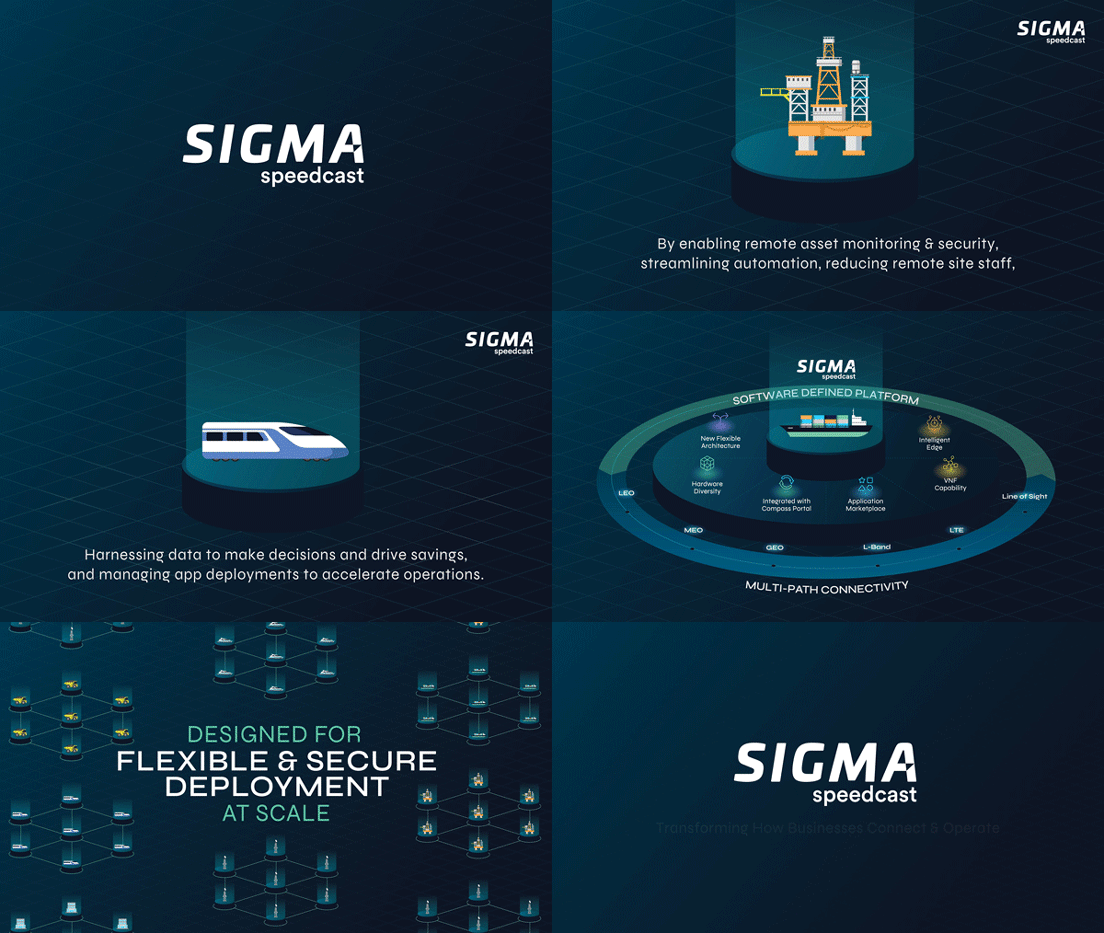
Today, nearly every new application is cloud‑native, so to deploy them properly, your edge compute platform must also be cloud‑native. SIGMA offers not only a cloud‑native platform, but also:
- Scalability, with no need for lengthy rollouts of expensive IT architectures.
- Auto‑provisioning of apps across the fleet at one touch.
- Much faster time‑to‑value for digital tools onboard.
SIGMA supports this shift by acting as the digital foundation for vessel networks. It enables software‑defined routing, application steering, link prioritisation, and smart load balancing—ensuring that new connectivity services and digital tools integrate seamlessly into daily operations.
Instead of lengthy hardware rollouts or manual configuration, applications can be provisioned and managed centrally, allowing fleet IT teams to scale digital capability without scaling complexity.

Insights like these are grounded not only in what the industry is planning for, but in what is already happening at scale. In the Future of Maritime Connectivity Report 2025, Valour Consultancy ranked Speedcast as the leading provider of LEO connectivity to maritime users globally by revenue. The company also placed second overall for maritime connectivity market share and for the provision of MSS broadband services.
Combined with experience supporting connectivity across more than 10,000 vessels worldwide—including market leadership in the Offshore Support Vessel (OSV) sector—these results reflect a deep, practical understanding of how maritime networks are evolving in real‑world operating environments.
As a Starlink Tier 1 Service Provider and Eutelsat OneWeb Global Distributor, Speedcast works closely with leading LEO providers today while actively preparing for future technologies, including emerging constellations such as Amazon Leo and Telesat. This multi‑orbit, multi‑provider approach ensures vessel operators are not locked into a single technology path, but are positioned to adopt new capabilities as they mature.
As vessel operators navigate the next phase of digitalisation, that experience reinforces a simple truth: future‑proofing isn’t about chasing speed for its own sake. It’s about building a network foundation that delivers insight, resilience, and adaptability—so ships can safely, securely, and efficiently adopt whatever comes next.
With the right strategy and the right platforms in place, connectivity stops being a constraint—and becomes a catalyst for progress at sea.
Ready to future‑proof your ship’s network?
Contact Speedcast to start the conversation.