























Uninterrupted connectivity is essential for maintaining operational integrity, safety, and productivity, especially across remote and distributed environments. As organizations increasingly adopt Starlink for its high throughput and low latency, many are now seeking ways to integrate the LEO service into a resilient business continuity architecture.
While Starlink delivers significant performance benefits, it cannot provide complete failover capability on its own. Achieving true zero downtime requires a multi‑path design, automated intelligence, and a robust edge platform capable of managing diverse connectivity sources under real‑world operating conditions.
Below, we outline key steps to designing a Starlink‑enabled failover solution that ensures constant availability, even in the most demanding settings.

Step 1: Build a Multi-Path Network Foundation
A resilient architecture begins with a multi‑path approach combining multiple, independent connectivity sources. For remote operations, this typically includes:

- Starlink as the primary communications link. Starlink’s high throughput and low latency provide excellent performance for day‑to‑day operational needs, especially for bandwidth‑intensive applications, real‑time monitoring, and cloud‑driven workflows.
- GEO VSAT for Predictability. GEO VSAT provides a dedicated CIR pathway, ensuring mission‑critical applications operate with stable latency, guaranteed bandwidth, and highly consistent performance—independent of overall site usage or environmental conditions.
- Optional LTE/5G or Secondary VSAT for Additional Resilience. In remote or offshore environments, additional network paths (such as LTE/5G or a secondary VSAT link) strengthen redundancy and ensure operational continuity if either Starlink or the primary GEO circuit experiences impairment or coverage limitations.
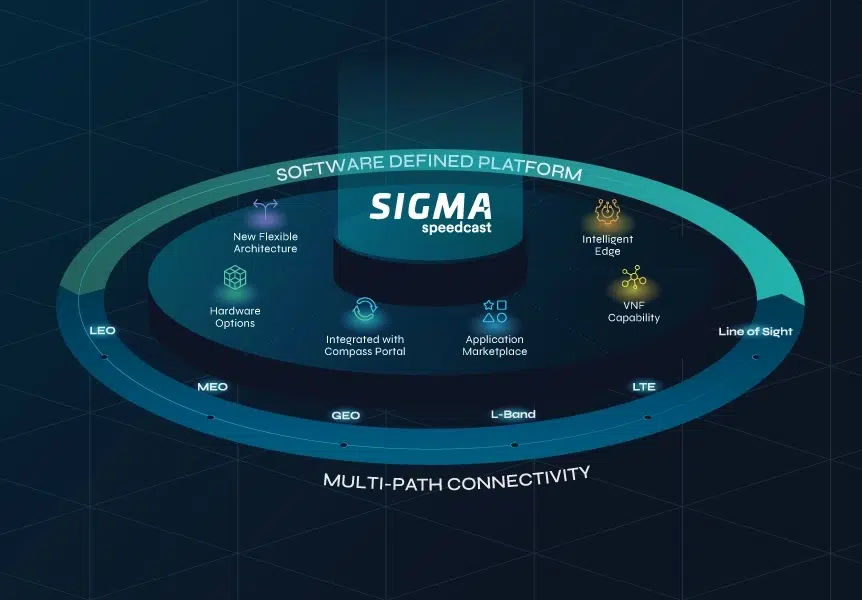
- Hybrid LEO for maximum performance and resilience. Speedcast’s Hybrid LEO combines multiple LEO networks into one SIGMA‑managed service, delivering higher uptime, smarter routing, and automatic failover for uninterrupted operations. With optional Ku‑band or MSS backups, it adds full‑path redundancy, simplifies management under one plan, and future‑proofs your network as automation and multi‑LEO visibility continue to advance.
A well‑designed multi‑path foundation ensures uninterrupted connectivity regardless of individual link performance.
Step 2: Implement Enterprise-grade SD‑WAN to Automate Failover
Simply having multiple network paths is not sufficient. Effective failover requires an intelligent orchestration layer capable of:
- Monitoring latency, jitter, packet loss, and throughput in real time
- Automatically shifting traffic to the optimal path
- Preserving active sessions during link transitions
- Adapting dynamically to changing network conditions
Without SD‑WAN, failover events can result in dropped sessions, service interruptions, or impacts to critical applications. Enterprise‑grade SD‑WAN ensures the network responds instantly, seamlessly, and consistently, without manual intervention.
Step 3: Use SIGMA as the Intelligent Edge and Orchestration Layer
Speedcast’s SIGMA intelligent edge platform provides the operational intelligence required to manage Starlink within a hybrid, multi‑path environment. SIGMA is specifically designed for complex remote operations and supports LEO, GEO, LTE/5G, and terrestrial connectivity.
With SIGMA, organizations gain:
- Continuous link monitoring and automated path selection
- Seamless transitions between networks with session persistence
- Application‑aware routing that protects mission‑critical workloads
- Secure, encrypted connectivity aligned with Zero‑Trust architectures
- Centralized visibility and control across all remote locations
SIGMA transforms Starlink from a single connectivity source into a fully orchestrated component of a resilient, enterprise‑grade communications ecosystem.
Step 4: Optimize Starlink and VSAT Roles Within the Failover Hierarchy
Once the network foundation is established, it is critical to define clear operational roles for each connectivity path.
- Starlink serves as the primary high‑capacity link, ideal for general operations, collaboration, cloud access, and high‑bandwidth applications.
- GEO VSAT supports CIR‑dependent workloads, ensuring predictable, stable performance for systems that cannot tolerate variability.
- Secondary VSAT or LTE/5G serves as additional backup, protecting against coverage gaps or environmental impacts affecting the primary paths.
Optimization is about ensuring each link is used for the workloads it best supports. SIGMA’s policy‑driven automation handles transitions seamlessly, maintaining operational consistency regardless of changing conditions.
Step 5: Apply Application‑Aware Policies for Critical Workloads
Every application has unique performance requirements. A modern failover architecture must differentiate between:
- Low‑latency, time‑sensitive workloads
- Mission‑critical operational systems
- High‑bandwidth but non‑critical tasks
- Periodic or deferrable traffic
Using SIGMA’s application‑aware routing, organizations can:
- Prioritize SCADA, access control, IoT telemetry, and safety applications
- Route voice, video, and cloud systems over the best available path
- Deprioritize or defer non‑essential traffic during failover conditions
- Maintain stability for CCTV, monitoring, and operational analytics
This granular control ensures that performance‑critical operations remain protected at all times.
Step 6: Establish Centralized Monitoring and Governance
A robust failover system requires unified oversight. SIGMA provides comprehensive visibility across all paths, enabling teams to monitor:
- Starlink link health and performance
- GEO VSAT, LTE/5G, and terrestrial network conditions
- Failover triggers and routing decisions
- Security alerts, policy adherence, and traffic behavior
- Overall bandwidth consumption and application performance
This centralized governance enables proactive management and reduces operational risk.

A Resilient Failover Architecture Requires Intelligent Orchestration
Starlink offers significant advantages as part of a modern business continuity strategy, but resilience depends on the strength of the surrounding architecture. When combined with a multi‑path network design and the SIGMA intelligent edge, organizations can achieve a truly fault‑tolerant environment that maintains uptime across offshore, remote, industrial, and enterprise operations.
As a Tier 1 Starlink Authorized integrator, Speedcast delivers this capability through deep expertise in hybrid networking, multi‑orbit communication systems, and intelligent edge solutions.

Want to explore a Starlink‑enabled failover solution for your operations?
Contact Speedcast now.